Live Air Quality Monitor
Air Quality Index
Philippines
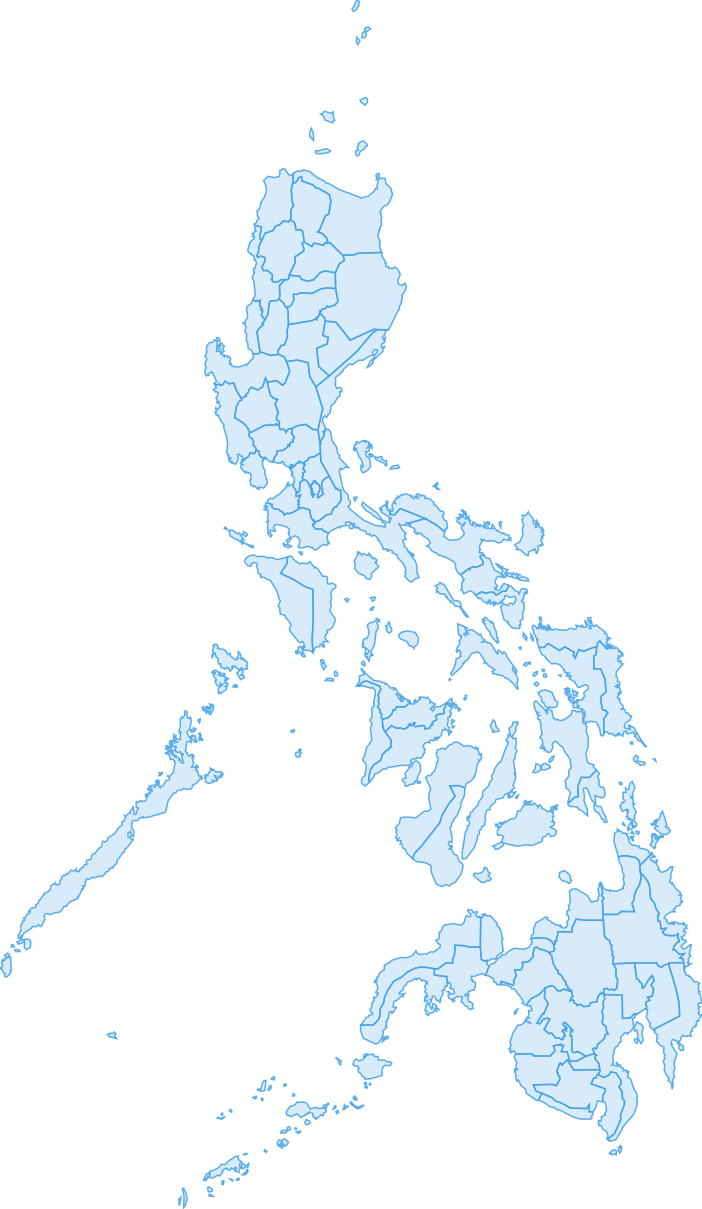
Live AQI and PM2.5 for 24 cities across Metro Manila, Visayas, and Mindanao. Use the Refresh button for the latest readings.
Live AQI and PM2.5 for 24 cities across Metro Manila, Visayas, and Mindanao. Use the Refresh button for the latest readings.
Air quality across the Philippines is updated every 10 minutes on this page. Metro Manila — home to over 13 million people — is the country's most polluted region, with AQI values frequently ranging from Moderate (51–100) to Unhealthy for Sensitive Groups (101–150). Cebu City and Davao City generally record lower pollution levels. The AQI scale used here follows the US EPA standard, measuring PM2.5, PM10, CO, NO₂, SO₂, and O₃. Scroll down for live readings from all 24 monitored cities.
AQI stands for Air Quality Index — a number from 0 to 500 that tells you how clean or polluted the air is at any given moment. The higher the number, the worse the air quality and the greater the health risk.
It's calculated by measuring six key pollutants: fine particles (PM2.5 and PM10), ground-level ozone (O₃), carbon monoxide (CO), sulfur dioxide (SO₂), and nitrogen dioxide (NO₂). The worst-performing pollutant determines the overall AQI. The scale used here follows the US EPA standard, which is the same one used by most global air quality apps.
In the Philippines, PM2.5 is usually the dominant pollutant — especially in Metro Manila where vehicle emissions are the primary source. Even a reading in the "Moderate" range means fine particles are present in the air you're breathing.
Air quality data is sourced from API Ninjas using real-time sensor and satellite data. AQI values follow the US EPA standard. Use the Refresh button to fetch the latest readings. Data is approximate and should not be used for medical or emergency decisions — refer to EMB Philippines (air.emb.gov.ph) for official government data.
The Philippines faces significant air quality challenges, particularly in urban centres. Metro Manila is consistently ranked among Southeast Asia's most polluted metropolitan areas, driven by a dense concentration of vehicles, industrial facilities, and construction activity. The city's geography — a low-lying basin surrounded by hills — traps particulate matter and limits natural ventilation, especially during the dry season from November to May.
The primary pollutant of concern is PM2.5 — fine particles smaller than 2.5 micrometers that penetrate deep into the lungs and enter the bloodstream. The World Health Organization sets a safe annual average of 5 µg/m³; Metro Manila regularly exceeds this by several times. Aside from vehicle exhaust, open burning of agricultural waste, industrial emissions, and construction dust are major contributors to the Philippines' air pollution burden.
Outside of Metro Manila, Cebu City and Davao City are growing rapidly and face increasing vehicular pollution. However, coastal cities in the Visayas and Mindanao often benefit from sea breezes that disperse pollutants more effectively. During typhoon season (June–November), rain naturally washes out particulate matter, temporarily improving AQI readings across all regions.
The Department of Environment and Natural Resources (DENR) through the Environmental Management Bureau (EMB) operates the Philippines' official air quality monitoring network. This page complements official data by providing real-time city-level AQI readings powered by API Ninjas, giving Filipinos an accessible, up-to-date snapshot of the air they breathe every day.